Promotional Notification Guidelines (Korea)
This guide summarizes the key points of KISA's (Korea Internet & Security Agency) app push advertising guidelines. For full details, refer to this file.
Definition of promotional information
Section titled “Definition of promotional information”Information that a for-profit company or individual sends to a recipient via app push notifications is, in principle, considered for-profit promotional (advertising) information.
There is, however, an exception: a sender who collected the recipient's contact information directly through a transactional relationship (such as the sale of goods) may send for-profit promotional information about similar goods within six months. Whether the promotional-information exception applies is determined by comprehensively considering the positions of both the sender and the recipient and the relationship between them.
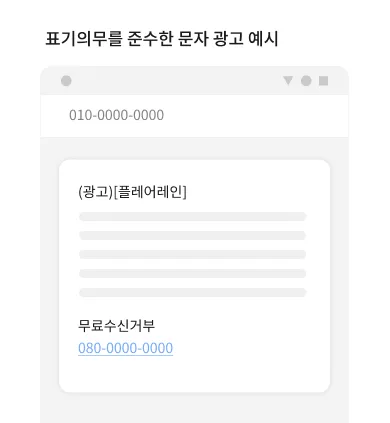
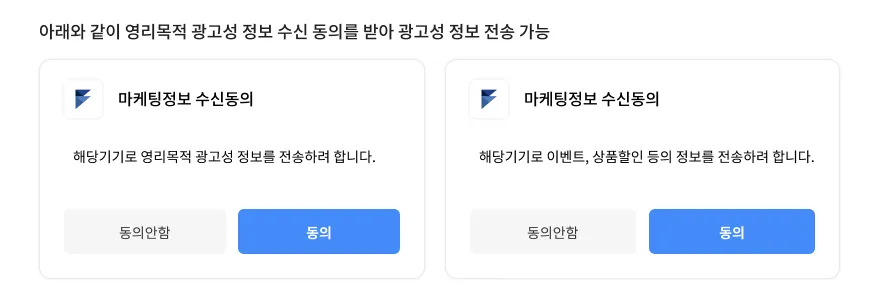
To send for-profit promotional information, you must 1. obtain the recipient's explicit prior opt-in consent, 2. clearly indicate (Ad), the sender's name, and contact information, and 3. provide an easy way for the recipient to opt out.
"Consent to receive promotional information" and "push notification permission" must be obtained separately. Therefore, simply asking whether the user permits push notifications (notifications ON/OFF) and obtaining that permission—rather than obtaining "consent to receive promotional information"—does not constitute consent to receive promotional information.
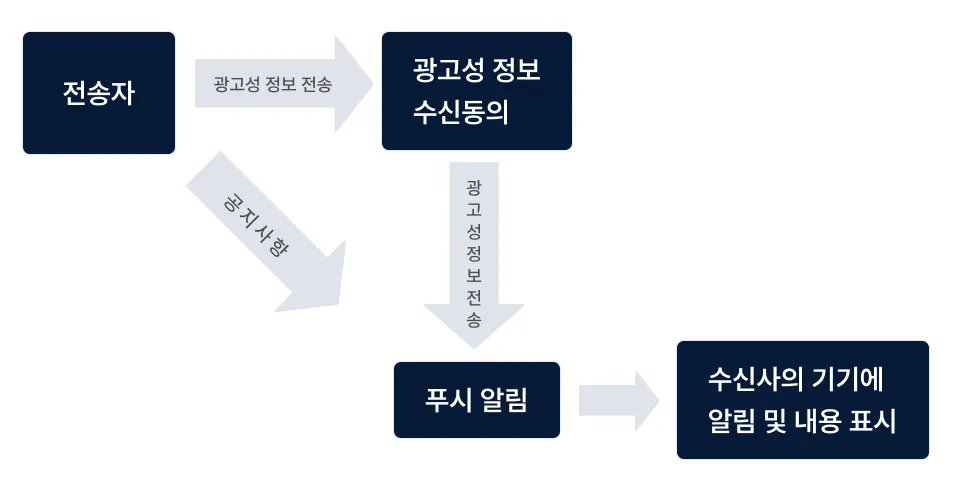
Consent to receive app push advertising can be managed separately from consent for other promotional channels such as SMS and email. If you obtain consent without specifying a particular channel, that member's opt-in and opt-out may be treated as applying across all channels.
To send promotional information at night, you must obtain separate consent for nighttime advertising.
The opt-in consent process
Section titled “The opt-in consent process”Before the app is first launched and the user logs in, you have no information about the recipient, so you cannot verify whether they have given consent. As a result, even if a recipient installs and launches the app, in principle you must not send promotional information to that device.
However, if you obtain "consent to receive promotional information" for that device—for example, by displaying a consent dialog when the app is first launched—you may then send push advertising to that device.
Once the recipient logs in within the app, you can identify who the recipient is, so you can send advertising according to the member settings (consent status) they configured. For customers who already consented to receiving promotional information when signing up via your website or offline, you can send promotional information without a separate consent process.
In FlareLane, you can record the time of opt-in consent and distinguish consenting recipients by integrating user profiles & tags.
Complying with disclosure requirements
Section titled “Complying with disclosure requirements”At the beginning of the promotional information, you must display (Ad), the sender's name, and contact information; at the end, you must clearly provide an easy way to opt out or withdraw consent.
What matters is that the required text is included—it does not matter whether that text is rendered correctly on the recipient's device.