'/%3e%3c/svg%3e)

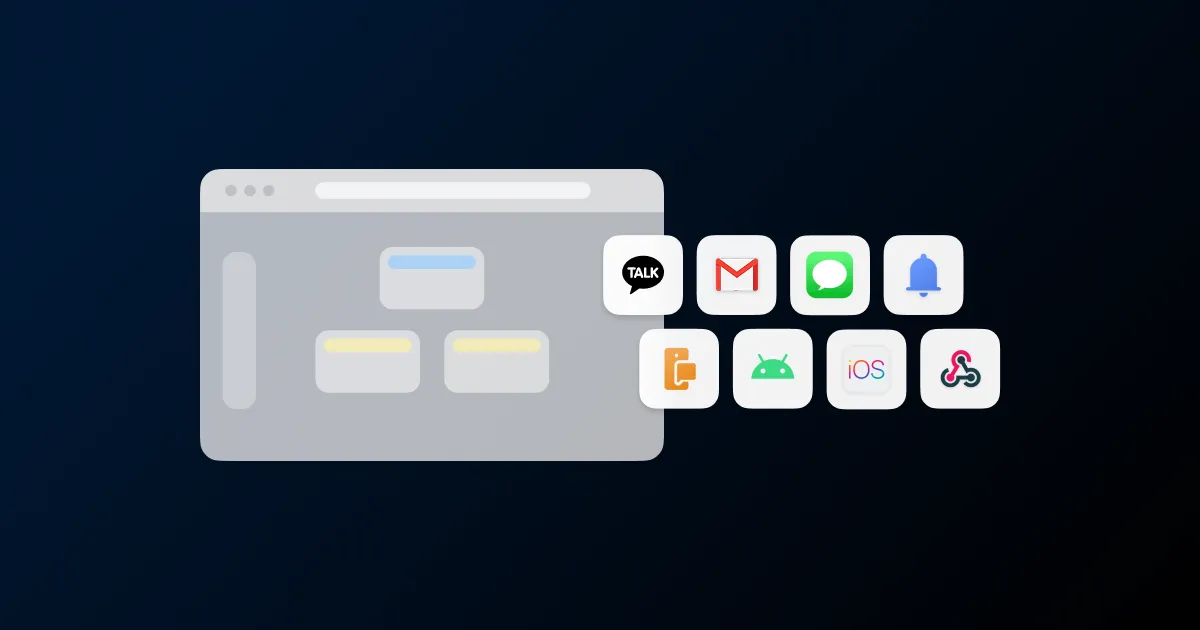
If you run CRM marketing in Korea, your team operates several channels. Kakao Alimtalk and BrandMessage push out notices and offers. App users get push. People you only have a number for get SMS. Email and in-app messages run alongside. More often than not, each channel sits in its own tool with its own owner.
One user moves across all of them to reach your service. Yet the operation still runs channel by channel.
From per-channel to per-user
Multichannel just means you run several channels. Push does its thing, Kakao does its thing, each on its own track. Metrics differ by channel, and user data scatters across them.
Cross-channel changes the reference point. It puts one user at the center and threads the channels that user passes through into a single flow. No reaction to the first push? Send Kakao the next day. Still nothing? Follow with SMS.
Users don’t decide to buy from a single channel. In a Harvard Business Review study of 46,000 global shoppers, 73% used more than one channel on the way to a purchase. Shoppers who used multiple channels made 23% more repeat visits within six months than single-channel ones.
In Korea, the channels are even more varied. In its 2026 marketing outlook, RocketTools flagged a split between the channel that drives traffic and the channel where payment lands: a shopper sees an Instagram ad but checks out on Naver Smart Store or Olive Young. Per-channel stats alone can’t stitch one user’s journey back together.
Run channels separately and two things happen. First, the same user gets near-identical messages across channels. Second, a user who already responded on one channel gets messaged again by another. You can see performance per channel, but nobody knows how much any one user actually received.
Kakao at the center of the channel mix
Korea’s channel mix isn’t the global one. Kakao sits at the center of reach. Kakao Alimtalk and BrandMessage land in a messenger people open every day, so they get read fast. Push only arrives for users who installed the app and opted in. SMS reaches anyone with a number but costs per message, and email is cheap but slow to get opened.
Even within one campaign, who gets which channel decides the outcome. A user who deleted the app won’t get push, so you reach them with Kakao Alimtalk. An active, opted-in user? Push first, since it costs nothing.
Most CRM tools built abroad, though, don’t treat Kakao as a first-class channel. To send Alimtalk, you bolt on a domestic delivery relay through a webhook or an external integration. It sends, but your ops team inherits the integration and the incident response.
FlareLane sends Kakao from the same screen as every other channel. As a Korea-based solution, it contracts directly with domestic carriers for Kakao and SMS. Kakao is inside the cross-channel flow from day one.
Connecting channels on one screen
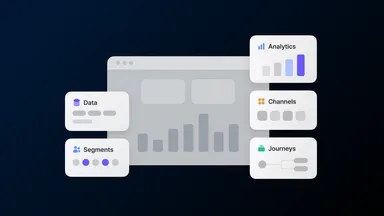
To run cross-channel, you need to compose the flow in one place instead of hopping between tools. FlareLane picks the audience with a segment. On the journey automation canvas, you lay out the channels that user will pass through, in order.
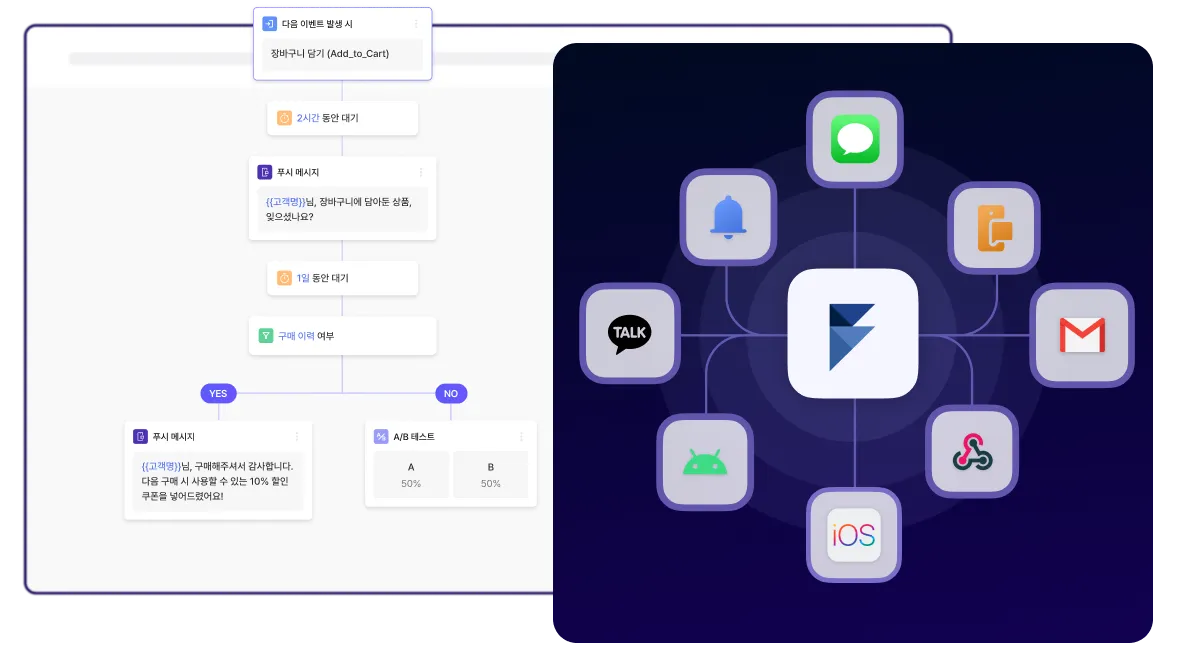
Set the entry condition, then chain branches, waits, and channel sends on the same canvas. Send a push three days after the first visit; for users who didn’t open it, follow up on Kakao. An AI agent drafts the automation, including who enters and the channel order, and you review it before switching it on.
Operate at the user level, and you can cap volume per user, too. Set frequency capping across the channel total, and a user who already got three messages this week won’t get more, no matter the channel.
Reading results on the same basis
Performance needs the same basis, too. Connect the sends but read results channel by channel, and your read on which channel drove the purchase goes wrong.
Last-click hands all the credit to the channel right before purchase. The push or Kakao that moved the user earlier disappears. FlareLane ties every message sent toward the same conversion within the attribution window to that conversion, and compares channel contribution on the same basis.
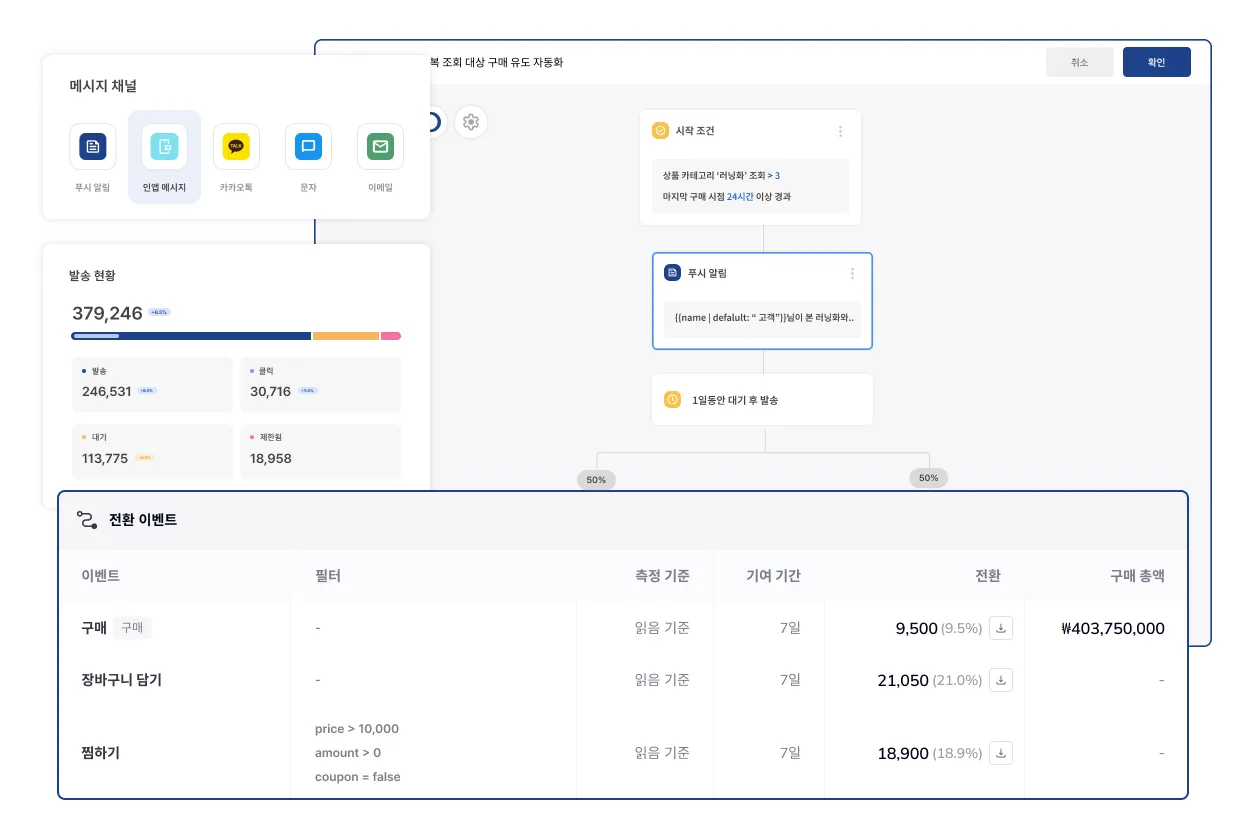
The measurement basis fits the channel, too. Push and email, where clicks are trackable, run click-based; Kakao and SMS, where clicks are hard to catch, run send-based. You go past conversion counts to total revenue by channel and campaign, on one screen.
Customer results and direct support
FlareLane publishes results from the customers that adopted it. Hyundai Home Shopping acquires leads 6x faster, and Home & Shopping and WingIt grew revenue and ROAS by 99.5% and 500%, respectively.1 It won customers from enterprises to startups with no outbound sales, on product strength alone. It took the Balanced Growth Award at the 2025 Innoforest Awards, which picks winners from real market-performance data rather than applications.
Onboarding and operations run through the head office directly, not a partner. With other tools, a salesperson walks you through setup and that’s the end of it. FlareLane staffs CRM specialists and an FDE2 apart from sales. After rollout, they shape segments and run campaigns with you to drive revenue growth directly. Integration and ramp-up wrap in under a month on average.
Scale out globally and the structure holds. Only Kakao is Korea-only; push, web push, email, and SMS send abroad as they are. The journey you ran in Korea with Kakao included can move to another market by swapping Kakao for whatever channel has reach there.
If you’re running channels separately and can’t gauge how much any one user receives, getting your current channels and data in order makes them faster to connect. You can request a cross-channel consultation below.

'/%3e%3c/svg%3e)