'/%3e%3c/svg%3e)

Teams evaluating Braze usually stall at pricing. There’s no public rate card. A quote comes only after a sales call.
That makes comparison hard. Line Braze up against another solution and one column comes back blank. But you can size Braze’s real cost from its public filings. With that number as the baseline, you can put FlareLane next to it on the same items and ask whether it replaces Braze, in Korea and beyond.
How Braze pricing is set
Braze doesn’t post rates on its site. Contract size swings hard with MAU1. An MAU is a user who opened your app or site at least once in a month.
Billing usually stacks in three layers. Your contracted MAU tier sets the base fee. Channels that cost per send, like SMS, sit on top. Then come the options: the Currents3 data-streaming module, extra workspaces, premium onboarding.
With no list price, you work backward from the filings. Braze posted $738.2 million in revenue for fiscal 2026 (ended January 31, 2026), across 2,609 customers. That lands near $280,000 per customer a year. The average isn’t the whole story. 333 customers pay $500,000 or more in ARR2. Top contracts start at double the average.
Budget from the base fee alone and you’ll drift once you’re live. Go past your contracted MAU tier and the overage bills at the same rate or higher. Get a quote built around push, then add SMS or a data integration, and the number climbs again.
Comparing on the same terms
Price is one axis. The channels you’ll send, the automation, and the analytics belong on the same scale.
| Comparison | Braze | FlareLane |
|---|---|---|
| Pricing model | Quote-only, MAU-based (~$280K per customer a year) | Scaled quote. Push, web push, in-app unlimited + SMS, email, Kakao billed per send |
| Push, web push, email, in-app | Yes | Yes |
| Kakao alimtalk, brand message | Hard to send natively | Sent from one screen |
| Journey automation | Visual canvas | Visual canvas |
| AI | Content generation, recommendations | AI Agent drafts automations, push copy, conversion attribution (human reviews) |
| Conversion and revenue attribution | Supported | Down to multi-touch revenue |
| Global enterprise references | Broad | Growing |
| Integration and ramp time | Usually 3 to 6 months | About a month on average |
| Local support, Korean | Often via a local partner | Direct from the vendor |
Push, web push, email, and in-app messages send well from both. Kakao is where they part. Braze can’t send Kakao alimtalk or brand message natively, and that’s the channel Korean services lean on most. Drop it and you’re routing around the gap.
Journey automation is the headline feature on both. Braze designs branching, delays, and sends visually in Canvas.
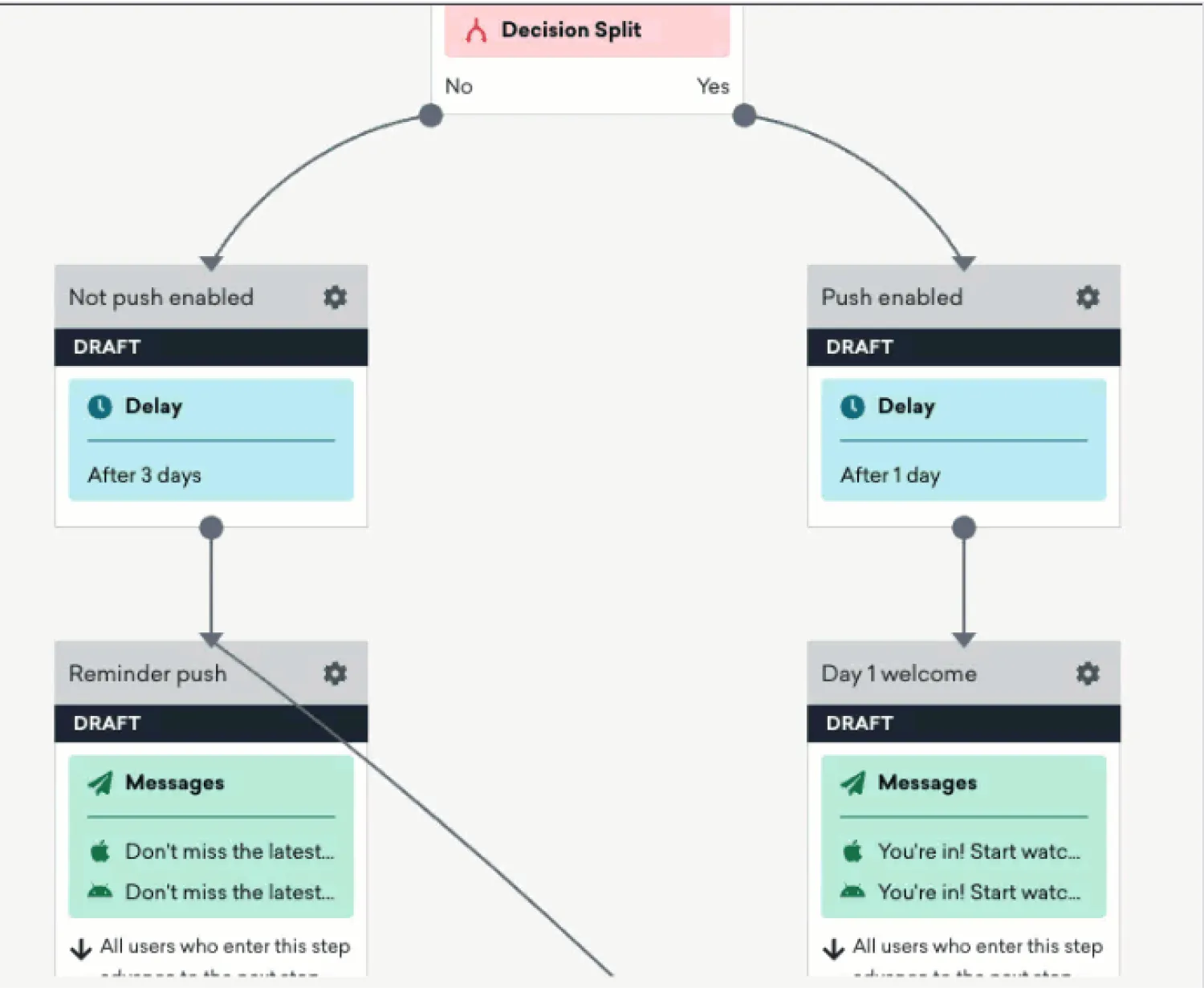
FlareLane does the same on a visual canvas. The difference is that it places alimtalk, push, SMS, and email on one screen. You build the branches, waits, and sends in one place instead of hopping between tools.
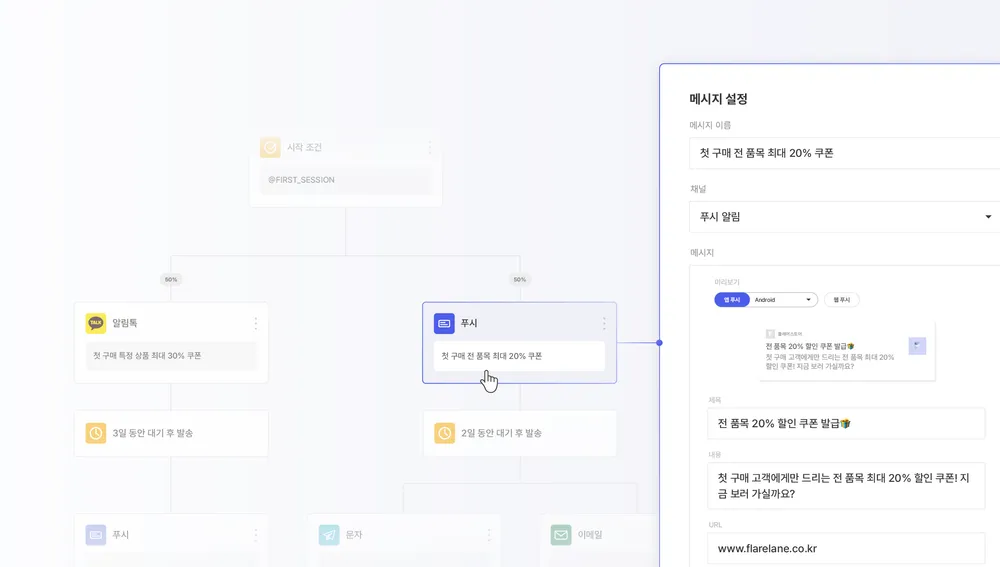
AI works differently too. Braze’s AI helps generate message content and recommendations. FlareLane’s AI Agent drafts automations, writes push copy, and analyzes conversion attribution, then a person reviews and applies it. Analytics don’t stop at sends, opens, and clicks either. They run down to multi-touch revenue.
Braze leads in places, clearly. Its global enterprise references and integration ecosystem run wide. If you want the reassurance of a long-proven platform, that’s a real strength.
Replacing Braze, in Korea and globally
For a Korean team, FlareLane is a replacement, not a supplement. It sends Kakao alimtalk and brand message alongside other channels on one screen, and prices to your scale. Push, web push, and in-app messages have no send limit. Only SMS, email, and Kakao are billed per send, so a high-volume push campaign runs without an MAU cap to watch.
Integration is designed for non-developers. SDK setup and event tracking take about three days on average, and full ramp stays under a month. Support comes straight from the vendor, in Korean. In Korea, Braze often runs through a partner, so even small questions can take time to answer. FlareLane also holds ISMS-P certification, which audits personal-data protection.
The same logic holds globally. The core jobs you ran on Braze, multichannel sending and journey automation, segmentation, and conversion measurement, work regardless of region. FlareLane sends more than 10 billion messages a year, handles over 200 million active users, and processes more than a million events a minute. That’s the scale to carry a large global campaign. Only Kakao is Korea-specific. Push, web push, email, and SMS send abroad just the same.
If you’ve gotten a Braze quote or are about to, sorting out your service’s MAU and the channels you’ll send makes the comparison faster. You can request a side-by-side comparison of both below.

'/%3e%3c/svg%3e)